

Quick Highlights
- TOEFL exam prep gets easier with a clear and focused plan
- Set your target and follow a simple study routine
- Use smart strategies for each section
- Practice with mock tests and improve weak areas
Feeling overwhelmed while preparing for toefl exam? Many students find it difficult to recognize where to begin, how to manage their time, and how to strengthen their areas of weakness, such as writing or speaking. With so many resources available, it can be confusing and stressful.
However, our guide is here to make things easier for you. You’ll receive a detailed, structured plan that will help you study more effectively, maintain consistency, and concentrate on the things that really raise your score. As a result, you can feel prepared as well as confident on test day.
Understanding the TOEFL Exam
The TOEFL exam assesses your English proficiency in four areas: speaking, writing, listening, and reading. You answer reading questions based on scholarly passages. Listening entails listening to talks and lectures where you should understand important concepts. However, writing includes essays based on assigned topics or readings, while speaking calls for brief, concise answers to prompts. The overall score is out of 120, with each section receiving a score of 30. The test typically lasts two hours. Therefore, it’s critical to maintain focus and practice time management.
Setting a Smart Study Plan for the TOEFL Exam
Assess your current English level
Knowing where you stand is crucial before you begin preparing. To determine your strengths and weaknesses, take a full practice exam or attempt sample questions from each section. It also allows you to concentrate more on the areas that require improvement rather than wasting time on the things you are already proficient in.
Set a realistic target score
Establish a precise target score based on your university’s or your visa’s requirements once you have determined your level. Aim for a score that is feasible in the time you have available, and be honest with yourself. Moreover, having a clear objective helps you stay motivated and gives your study strategy focus.
Create a weekly study schedule
Make a weekly schedule that covers each of the four sections without being too demanding. Divide your study time into manageable chunks and give yourself specific assignments, such as speaking drills, listening exercises, or reading practice. In addition, try to study a little each day because consistency is more important than long study sessions.
Recommended prep timeline (4 to 12 weeks)
Depending on the starting point and desired score, most students take four to twelve weeks to prepare for the TOEFL. A shorter plan might work if your fundamentals are solid, but give yourself more time if you need to make more progress. Starting early, practicing frequently, and giving sufficient time for review and practice exams before your test are crucial.
Quick Research
Do you know? The average overall score on the TOEFL iBT test is about 86 out of 120, with average section scores around 21–22 in reading and listening and about 20–21 in speaking and writing, showing how most test takers perform across skills.
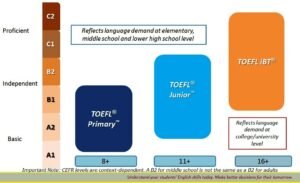
Graph showing TOEFL exam average scores for reading, listening, speaking, and writing sections.
Source: TOEFL iBT 2024 Test and Score Data Summary
Section-wise Preparation Strategy for the TOEFL Exam
Reading
Instead of reading every word, concentrate on skimming and scanning to raise your reading score. While scanning helps in locating specific details, skimming facilitates rapid understanding of the main idea. To become familiar with the format and degree of difficulty, practice frequently with academic passages that are similar to those on the test.
Listening
Effective note-taking is essential for the listening portion. While listening, jot down key points, keywords, and significant details rather than attempting to recall everything. In order to understand a range of speakers during the test, it is also beneficial to expose yourself to various English accents through lectures, podcasts, or videos.
Speaking
Complex vocabulary is less important in the speaking section than clarity and structure. Learn to arrange your responses using a straightforward structure, such as providing a main point, a justification, and an example. To become familiar with thinking and speaking rapidly and without hesitation, practice responding to questions within the allotted time.
Writing
Learning a clear essay structure with an introduction, body paragraphs, and conclusion is a good place to start when writing. Instead of using complex vocabulary, concentrate on arranging your thoughts logically. To write more quickly and confidently on the test, you can also practice common TOEFL topics regularly.
Practice and Mock Tests for the TOEFL Exam
- Take full-length mock tests often
Don’t just practice individual sections. Doing full tests actually gets you ready for the real thing. Therefore, you’ll build stamina, get better at managing your time, and start feeling comfortable in the exam setting.
- Try to replicate real exam conditions
Find a quiet spot, turn off your phone, and stick to the real test time limits. Doing this makes you less anxious and mentally prepares you for the big day.
- Deeply engage with your mistakes
After each test, look over every question you missed. Figure out exactly where you went wrong. Watch for patterns, like weak vocab or tight deadlines.
- Keep tabs on your progress
Jot down your section scores after each test. Looking back, you’ll spot your improvements and know which parts still need attention. It can be pretty motivating.
- Target your weak spots
Use what you learn from your mock tests to tweak your study plan. Put in more effort on your lowest-scoring areas instead of spreading yourself thin over every section. That’s how you make real progress.
TOEFL Exam Day Tips
- Bring your valid ID and required documents, and check everything the night before.
- Arrive early so you have time to settle in and avoid stress.
- Also, keep track of time. Don’t spend too long on one question.
- Stay calm, take a breath if you feel nervous, and refocus.
- Read and follow all instructions carefully before starting each section.
If you’re exploring other English proficiency options, check out our guide on Language cert test prep to compare formats, scoring, and preparation strategies.
Where to Get Reliable TOEFL Exam Guidance in Karachi?
If you’re looking for structured support, IQQAC can be a reliable option for both preparation and testing. As a preparation and test center, IQQAC offers guidance that aligns closely with the actual exam format, which can make your practice more effective. You can also benefit from IQQAC’s practical tips, feedback on weak areas, and occasional discounts on enrollment, making it easier to access quality prep without overspending.
Frequently Asked Questions
Q1: How long does TOEFL prep take?
Most students prepare in 4 to 12 weeks, depending on their level and target score.
Q2: Is the TOEFL exam difficult for beginners?
It can feel challenging at first, but regular practice makes it manageable.
Q3: What is a good TOEFL score?
A score above 90 works for many universities, but top ones may require 100 or more.
Q4: Is IQQAC a good option for TOEFL preparation in Karachi?
Yes, IQQAC offers structured guidance, test-focused practice, and helpful feedback to improve your score.
One Comment
Comments are closed.




[…] Do you also want to learn TOEFL exam preparation? Read our blog to explore quick tips about TOEFL exam prep. […]