
Quick Highlights
- Practice the latest IELTS speaking topics for all three test parts.
- Implement effective speech strategies to become a more fluent speaker and to increase your band score.
- Work through a basic four-week practice plan, and practice mock speaking regularly.
- Learn from common pitfalls and be confident and well-prepared with IQQAC’s expert guidance.
Practicing for the IELTS Speaking test is not just about memorising responses. You will need to practice regularly with the appropriate IELTS speaking topics. You will also need clear speaking strategies that enable you to answer in an easy, confident manner. This guide includes the updated list of IELTS speaking topics, some questions that are commonly asked in the IELTS speaking test, and simple strategies to help Pakistani students and professionals boost their IELTS score in the speaking section.
Before you begin your daily practice, take a mock test to assess your current level and identify the areas for improvement.
IELTS Speaking Format and 2026 Trends
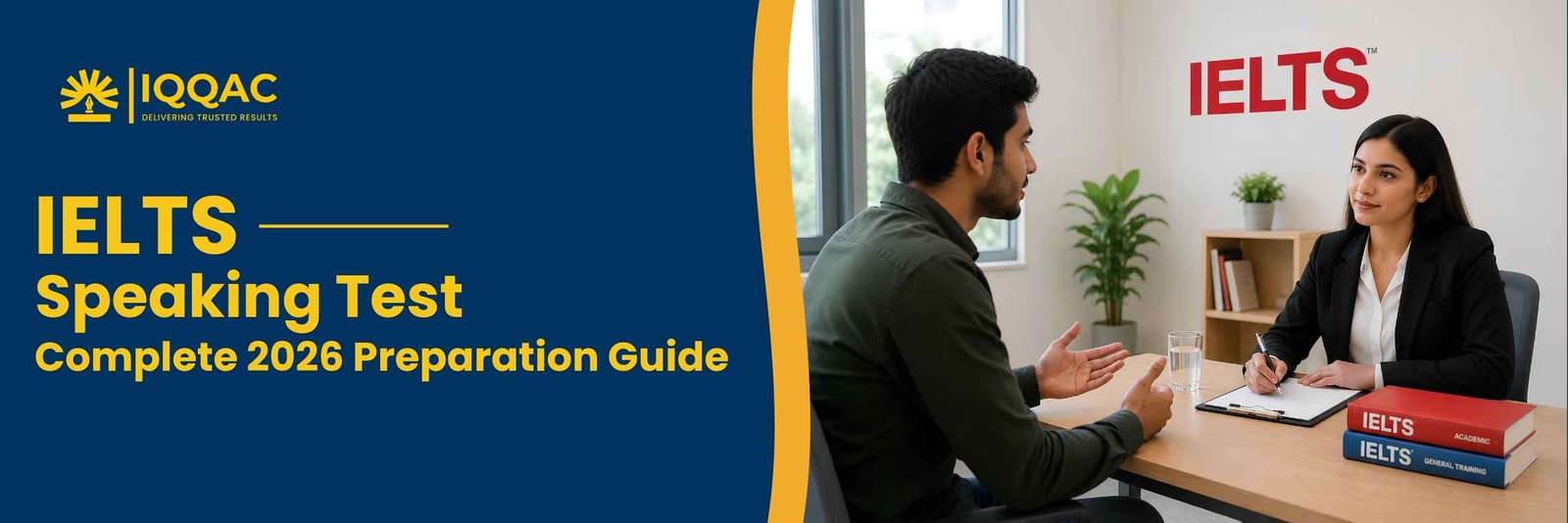
The Speaking test consists of three parts. Each component assesses various communication competencies.
Part 1: Introduction and Interview
This section should take approximately 4-5 minutes. The examiner questions you with basic questions regarding your daily life. Common subjects include:
- Work or study
- Home
- Family
- Hobbies
- Food
- Technology
- Travel
Part 2: Cue Card
This portion should take approximately 3-4 minutes. You get one topic card. You will have one minute to prepare. Then you give an uninterrupted speech for up to 2 minutes.
Part 3: Discussion
This is a 4-5 minute section. The examiner gives more detailed questions about the topic of your cue card. The ideas should be explained, situations should be compared, and opinions should be backed by examples.
How IELTS Speaking Is Scored
The examiner assesses you on 4 criteria.
- Fluency and Coherence
- Lexical Resource
- Grammar Range and Accuracy
- Pronunciation
Band scores are made up of good performance in all four areas.
IELTS Speaking Trends for 2026
The IELTS speaking topics are also similar to the ones that are related to real-life scenarios and not to academic topics. Technology, education, online learning, health, work-life balance, culture, and environment are frequently discussed. The speaking interview is a live interview with a real examiner and does not differ from the computer-delivered IELTS. So, focus on recent IELTS topics for speaking rather than on the old ones.
Top IELTS Speaking Topics for Part 1
In Part 1, you are tested on how well you can talk naturally about familiar topics. These are the most frequently asked IELTS speaking exam questions:
- Work
- Study
- Hometown
- Home
- Family
- Friends
- Reading
- Sports
- Technology
- Shopping
- Travel
- Music
- Food
- Social media
- Festivals
Sample Part 1 Questions
These are some practice questions.
- What do you study?
- What is the purpose of your choice of subject?
- Do you like your job?
- Describe your hometown.
- Are you interested in cooking?
- How many times do you go on trips?
- What type of music do you enjoy?
- What is the importance of technology in your life?
- Would you like to shop online?
- What is the usual activity on your weekend?
- Which season do you like most?
- Likes reading books?
- What is it that makes a good friend?
- How often do you travel by public transport?
- What hobby would you like to learn?
Work on short answers that are about 20-30 seconds. If possible, one reason, one example. This way is natural and will make you fluent. Use a timer during practice. Next, ask yourself follow-up questions to gain confidence.
Top IELTS Speaking Topics for Part 2
You will need to write longer answers for Part 2. Good planning helps you to be organized.
Popular themes for cue cards are:
- A memorable journey
- A helpful person
- Your favorite teacher
- A special gift
- A useful mobile app
- Successful event
- A historical place
- A beautiful park
- Difficult decision
- A family celebration
- An inspiring book
- A useful skill
- A childhood memory
- An important achievement
Simple Planning Template
When talking, use this structure first.
Introduce the topic.
- Explain the background.
- Share personal details.
- Describe the experience.
- Conclude with your opinion.
This straightforward organization helps you keep your ideas together. Your answer is thus easier to follow.
Include linking words/phrases like:
- First
- After that
- For example
- Besides that
- Because of this
- Finally
Natural connectors help make it coherent and do not sound memorized.
Want to take a test in Karachi? Check how IQQAC ensures a smooth English Proficiency Test.
Top IELTS Speaking Topics for Part 3
Your opinions are explained in more detail in Part 3. Typical types of questions include:
- Opinions
- Comparisons
- Predictions
- Advantages
- Disadvantages
- Causes
- Solutions
Sample Discussion Questions
Education
- Should universities have a greater number of online courses?
- What skills should be taught in school today?
Technology
- In what ways has technology impacted communication?
- Will AI take away some jobs?
Environment
- What are the reasons to recycle?
- What are the steps for a government to help decrease pollution?
Culture
- Why is it important to have traditions?
- Are cultural values to be preserved by young people?
How to Expand Your Answers
Make the following simple pattern.
- State your opinion.
- Give one reason.
- Add one example.
- Explain the result.
This structure demonstrates good thought and better response quality.
Model Answers and Band-Based Templates
Grammar is more important than length of answer for higher bands.
Band 6
Answers stay simple. Vocabulary remains basic. Some grammar errors are found occasionally.
Band 7
Answers stay organized. Vocabulary grows in diversity. Grammar improves. Examples are used for ideas that are relevant.
Band 8
Your answers have a natural and confident sound. Vocabulary becomes precise. Grammar remains accurate. Ideas are developed fully and smoothly transitioned.
Useful Response Template
- I believe…
- One reason is…
- For example…
- Therefore…
Use this model for various IELTS speaking topics rather than the complete responses. Also, the use of useful vocabulary boosts your score. Examples include:
- Work-life balance
- Environmental awareness
- Digital communication
- Career development
- Public transportation
- Cultural diversity
- Healthy lifestyle
Record your answers every week. Then, compare them to the IELTS scoring criteria. It will be easier to see the changes you are making.
Four Week Speaking Practice Plan
Short studies are more effective than long studies.
Week 1
Do Part 1 each day.
Answer various IELTS speaking topics for 20 minutes each.
Week 2
Do one cue card per day.
Record every response.
Listen to the recording and check your pronunciation after each one.
Week 3
Make sure to discuss Part 3.
Make all answers extensive, supported by reasons and examples.
Week 4
Take part in a full speaking interview. Track your progress using these points.
- Speaking speed
- Hesitation
- Vocabulary variety
- Grammar accuracy
- Pronunciation clarity
Work with a study partner (if possible). Getting honest feedback means learning at a faster rate.
Want to explore a different but quick proficiency test? Explore Oxford ELLT Pakistan to understand another recognised English language assessment pathway.
Common Speaking Mistakes and Quick Fixes
There are some common errors that many candidates make. Common problems include:
- Memorized answers
- Speaking too fast
- Very short responses
- Repeating the same words
- Long pauses
- Incorrect pronunciation
- Weak grammar
- Poor eye contact
- Ignoring the question
- Limited vocabulary
- These can all be corrected by regular practice.
- Read, read, read every day!
- Shadow native speakers.
- Practice paraphrasing.
- Record your answers.
- Review your mistakes.
Look into AI tools to help provide feedback, but don’t copy and paste pre-made scripts. Always answer in a natural and personal way. For reliable preparation, use official resources from the British Council, IELTS.org, and Cambridge English.
Your Gateway To International Language Testing & Preparation
Looking to get your desired IELTS level? IQQAC provides you with an environment that is reliable and secure for your English proficiency test. We are with you from the beginning of your booking till test day. We also give you preparation help, practice tips, and expert help to boost your confidence before you show up for your test. No matter what your aim is to enhance your speaking abilities or get ready with structured practice. Book your test with IQQAC and achieve your international education and career targets with dependable testing and preparation solutions.
Frequently Asked Questions
Q1: What are the IELTS speaking topics for 2026?
The most popular topics are still work, education, technology, traveling, family, environment, and hobbies.
Q2: How much time should be spent on answering Part 1?
Try to keep the answers to 20-30 seconds a piece.
Q3: Is it possible to learn the answers to the IELTS Speaking test?
No. Memorized responses are easily recognized by the examiners.
Q4: How many times should I practice IELTS Speaking?
Do 20-30 minutes of practice each day to improve the skill.