Quick Highlights
- Understand the cue card format to avoid surprises on test day.
- Use IELTS cue cards every day to become more fluent.
- Organize answers in a simple structure.
- Use frequent mock tests to monitor progress.
For the IELTS test in Karachi, you need to be confident in all four sections. Many students focus on Reading and Writing. However, they often struggle with IELTS cue cards during the Speaking test. The main reason is simple. They can’t speak for more than 2 minutes without being pressured.
The good news is that cue cards follow a clear format. Practicing them daily will help you develop and refine your skills with the proper technique. This guide covers the Speaking band score format, as well as how to structure your answers to score well.
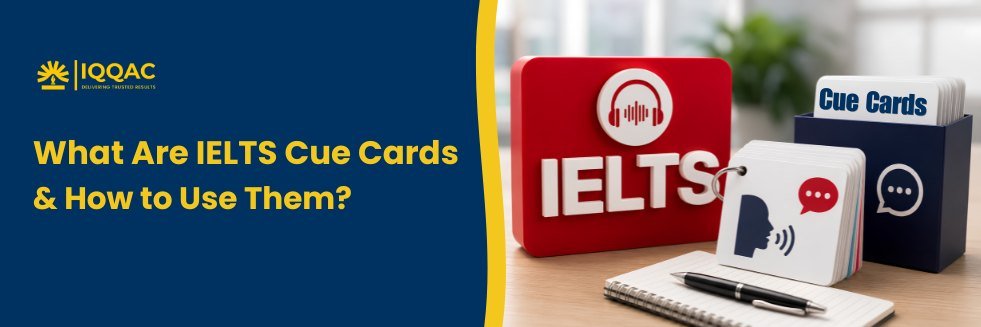
What Are IELTS Cue Cards?
In the IELTS Speaking test, Part 2 contains IELTS cue cards. After Part 1, the examiner gives you a card with one topic and several bullet points. There is 1 minute to prepare ideas. After that, there is a 1-2 minute speaking period. A typical cue card will contain:
- One main topic
- Three to four bullets
- One minute for preparation
- Speaking 1-2 mins
You might be given a topic, for instance:
Describe a place you enjoy visiting.
You may need to explain:
- Where it is
- When you visited it
- Why you like it
- Why you would recommend it
The examiner expects a running speech. Each bullet point needs to be covered and should also include personal ideas and examples. IELTS cue cards are important because Part 2 directly affects your total Speaking score. Excellent performance indicates the ability to arrange ideas, speak fluently, and communicate naturally.
Understanding the IELTS Cue Card Task and Marking Criteria
Many students believe they have to get the correct answers. But the examiner is searching for effective communication.
Each cue card contains one topic and some cues. The prompts are just to guide you in structuring a response. You do not have to say them word for word, but you have to speak them naturally. The examiner scores your response using four criteria.
Fluency and Coherence
Talking smoothly with no pauses. Clearly tie in your ideas. Use simple sequencing words like “first,” “after that,” “because,” and “finally” to make your answer flow.
Lexical Resource
Use a variety of vocabulary. Use synonyms for repeated words. But do not use difficult words that you do not know how to pronounce.
Grammar Range and Accuracy
Correctly use various sentence structures. Use simple and compound sentences, but prioritize accuracy.
Pronunciation
Speak clearly. Maintain a natural pace. Pronounce key words properly and read familiar words with confidence. Higher band scores typically contain:
- Clear organization
- Relevant examples
- Good vocabulary
- Few grammar mistakes
- Natural pronunciation
You can review the official IELTS Speaking band descriptors.
Preparing for IELTS Cue Cards: Study Plan and Practice Techniques
Many students improve quickly because they follow a consistent routine. Long study sessions once a week don’t work very well, but daily practice does.
Create a Weekly Practice Plan
Use one cue card a day.
Week 1 reviews familiar topics.
The second week has more challenging topics.
Week 3 contains timed speaking activities.
Week 4 combines mock Speaking tests.
This way, your confidence naturally builds up.
Analyze Common Topics
The majority of the IELTS cue cards are of the following types:
- People
- Places
- Experiences
- Objects
- Events
- Books
- Technology
- Hobbies
Do not memorize answers, but rather come up with ideas for each category. Then modify them for the test.
Build Topic Vocabulary
Study bits of useful vocabulary together instead of cumbersome random words. For example, travel vocabulary can include:
- breathtaking view
- local culture
- public transport
- historical building
- unforgettable experience
Practice these phrases until they become natural.
Record Yourself
Keep track of all practice sessions. Then ask yourself:
- Was it two minutes?
- Have I addressed all the bullets?
- Did I repeat words?
- Were there too many pauses?
- Enough to be believed?
Self-evaluation is used regularly to identify errors before test day.
If you are comparing different English tests, read our guide on PTE in Pakistan.
A Step-by-Step Strategy to Use IELTS Cue Cards During the Test
Having a strategy helps keep you cool if the topic is new.
Use Your One Minute Wisely
Use the first minute to develop a quick plan.
Write:
- Main idea
- Three supporting points
- One personal example
A simple outline ensures that your answer is organized.
Follow a Simple Structure
This is a pattern your answer will take:
- Introduction
- State the subject in one sentence.
- Main Body
- State your ideas in a sequence.
- Include examples and anecdotes.
- Ending
- Conclude with a final thought or opinion.
This is a way to stay on track when you start talking normally.
Use Natural Linking Words
Link ideas to phrases like:
- First
- Next
- Besides
- For example
- As a result
- Finally
These changes make the text more fluent and natural-sounding.
Handle Unfamiliar Topics
Sometimes you may receive a difficult topic. Do not panic.
Instead:
- Refer to a comparable instance from your personal life.
- Think of a realistic scenario.
- Add simple details.
- Keep speaking confidently.
The examiner cares more about what is said than what is correct.
Sample IELTS Cue Cards and Model Answer Blueprint
This is a typical case. Write a description of someone who has inspired you.
You should say:
- Who the person is
- How you know them
- What they did to inspire you:
- What you learned from them
The simplest answer construction is this one.
Opening
Introduce the person.
Background
Explain your relationship.
Main Story
Describe a memorable experience.
Lesson
Describe what you have learnt.
Closing
Finish with your overall opinion.
This is an ideal blueprint for a lot of IELTS cue cards as it makes your answer sound logical.
Some good starting words are:
- Yesterday I wrote about…
- A person that I always recall is…
- A remarkable event occurred when…
Phrases to close with:
- Overall, it was an amazing experience.
- I was given a great lesson.
- I remember all this still today.
You can provide more details for short answers:
- Examples
- Feelings
- Reasons
- Results
- Plans
This makes 2 minutes a much more attainable goal.
If you also want to prepare for other Speaking sections, check out our IELTS Speaking Topics guide.
Practice Resources, Tools, and a 4 Week Improvement Plan
Quality resources are crucial to good preparation. Useful resources include:
- Official IELTS practice materials
- Cambridge IELTS books
- Speaking practice videos
- Vocabulary flashcards
- Speaking partners
You can also use free resources from the British Council.
Daily Ten Minute Routine
Spend:
- 2 minutes to read the topic.
- One minute planning.
- Two minutes speaking.
- Three minutes reviewing.
- Vocabulary improvement for 2 minutes.
After just 10 concentrated minutes a day, you can see steady improvement.
Four-Week Plan
Week 1
Use familiar IELTS cue cards to build confidence in IELTS.
Week 2
Increase vocabulary and fluency.
Week 3
Take full-time Speaking practice tests.
Week 4
Analyze errors and refine pronunciation.
After each session, record how long you spoke, words learned, grammar mistakes, and confidence level. Progressing each week makes a big difference at test time.
Before booking your exam, check our complete guide on IELTS Test Fee in Pakistan.
Book Your IELTS Test with IQQAC
Your preparation deserves a trusted test centre. IQQAC will give you a secure and safe place to take your IELTS exam. Our team is here for you from booking to test day. We also provide support with preparation so you can feel confident before you take your exam. From professional assistance to a hassle-free testing experience, IQQAC has got you covered in Karachi. Book your IELTS test today and take the next step toward your academic or professional goals with confidence.
Frequently Asked Questions
Q1: What are IELTS cue cards?
They are Part 2 Speaking tasks in which you speak for 1-2 minutes on the topic.
Q2: How many cue cards do I need to practice?
Learn and review new cue cards one or two at a time each day, and review earlier topics periodically.
Q3: Can I make up a story in the IELTS Speaking test?
Yes. Use real examples if they will help you to answer the topic naturally.
Q4: What are the ways to get better at cue cards in a short period of time?
Practice every day, take notes, correct your answers, and then talk under timed circumstances.