Quick Highlights
- Learn how to manage your 60 minutes and answer all 40 reading questions effectively in the IELTS reading test.
- Use simple strategies for multiple-choice, True or False, matching, and completion questions.
- Improve your score with skimming, scanning, vocabulary, paraphrasing, and critical reading.
- Follow a practical 12-week study plan with timed practice and detailed error review.
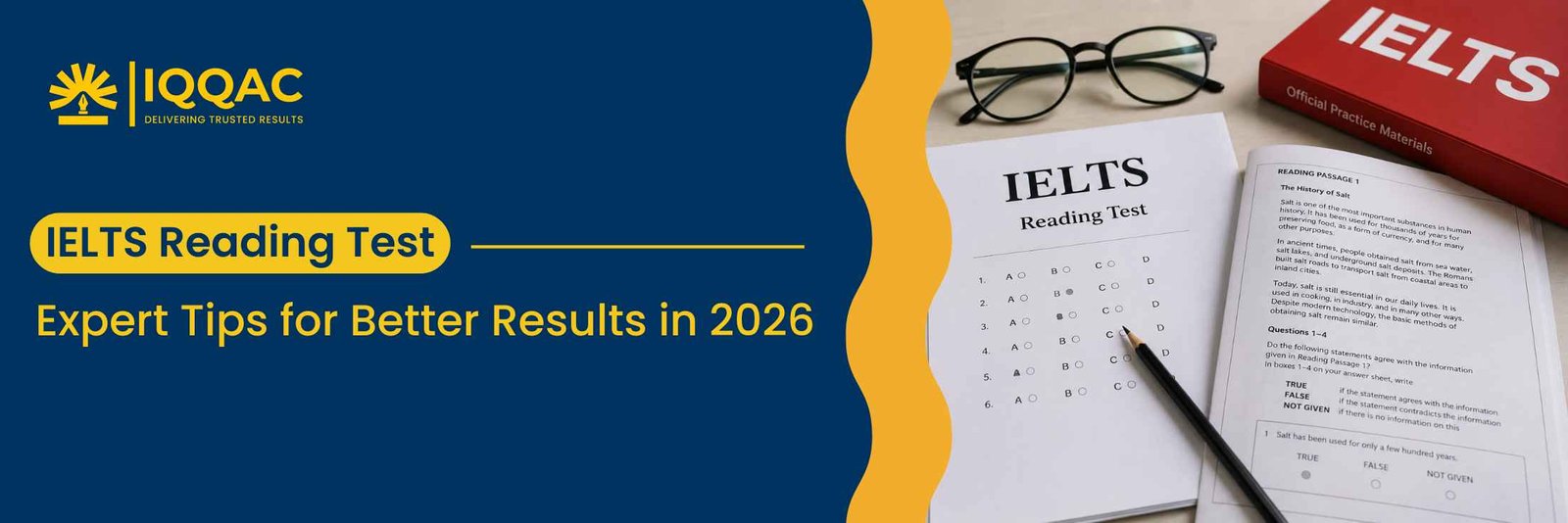
Struggling to finish on time or reach your target band? You should have a clear plan. The reading test of IELTS assesses your ability to locate information, comprehend ideas, and follow meaning. You don’t have to read each word out loud. Rather, you must have savvy timing, helpful vocabulary, and practice. This guide provides you with some practical tips for the IELTS reading test for 2026.
What to Expect in the IELTS Reading Test in 2026
Both Academic and General Training versions provide you with 60 minutes, 40 questions, and three sections. But the material read is different. Academic writing frequently addresses issues related to study and academic topics. General Training contains more texts from everyday and workplace contexts, and a much longer and more complex final section. The transfer time is not an additional allowance of paper, so plan your answers within the 60 minutes.
The IELTS reading test is available both on paper and on a computer at the test centre. The questions and format remain unchanged, but the approach to answering is different. For a computer, you read the problems from the screen and enter your answers into the computer. So practice scrolling, navigating between questions, and using the screen tools.
On Academic Reading, around 23 correct answers are typically considered band 6, 30 correct answers are typically considered band 7, and 35 correct answers are typically considered band 8. More correct answers will typically be required for the same band for the General Training. The above numbers, however, may be slightly different depending on the test versions. Don’t use them as a strict rule. For more information, check IELTS scoring details.
Common Question Types and Simple Tactics For IELTS Reading Test
Multiple choice questions can be time-consuming. To answer the question, first identify the section of the text that contains the answer. Then, remove options that disagree with the text. Lastly, check the other options against the actual meaning. Look for distractors that are similar in wording to the passage but have different meanings. You can also check the official IELTS reading format for better understanding.
True means the passage supports the statement, for the answers True and False. False – the meaning of the passage is incorrect. Not Given: The passage does not contain sufficient information. Hence, refrain from using your personal knowledge. They apply to Yes, No, and Not Given questions as well.
If matching headings, read the first sentence and recognize the main idea of the paragraph. Do not use a heading for the reason that one word is the same. Look at the entire paragraph instead. Read sentence stems for sentence endings. After that, identify the concept in the text that is related.
In short answer, summary completion, and sentence completion questions, adhere strictly to the word limit. On an item that has the instruction “NO MORE THAN TWO WORDS,” write no more than 2 words. Secondly, do a spelling test before proceeding. Although these are minor, it is possible to lose marks for small spelling mistakes.
You can also consider another English proficiency option when your university or visa route accepts it. IQQAC offers LanguageCert testing support, and its LanguageCert vouchers can make booking easier when you choose that test.
High Impact Reading Strategies For IELTS Reading Test
Skimming allows you to grasp the structure of a text quickly. Read the title, headings, first lines, and keywords first. Then look at key final sentences. This will help you get a map that you can use before answering. Afterwards, look for names, dates, numbers, places, and unusual words. Do not look for the exact words of the question, though. It is common for IELTS to paraphrase. For instance, the word “increase” can be used as “rise.” So, expand your vocabulary of synonyms while you are practising for the IELTS reading test.
Special attention is required with inference questions. The answer might not come across in a single sentence. Rather, search for clues in sentences around the target sentence. Additionally, look for words like however, although, only, and unlikely. These words can have multiple definitions. The question must be followed by the method of reading. Take a skimming approach when you are looking for the main idea. If you need a detail or the writer’s perspective, read carefully. Therefore, this question-based method is a time-saving method as you are not giving the same amount of attention to every sentence.
Time Management for Better Results For IELTS Reading Test
You will have 60 minutes, so plan your time before you start. Attempt approximately 17 minutes for section one, 20 minutes for section two, and 23 minutes for section three. The last section is typically the area that requires additional focus. Don’t take 5 minutes on one difficult question. Rather, note it and proceed on to the next one, and then come back later. Do the easier questions first. This will not only help maintain your score but also your pace as well.
Also, don’t overread. If a sentence seems too hard, read the sentences surrounding it. Then, ask the question to clarify what is important. It is not essential to know all the words in the IELTS reading test. Practise with a timed mock test each week. At the end of each session, take a look at your errors and write down what types of questions you are getting wrong.
Build Vocabulary, Paraphrasing, and Critical Reading Skills
Memorise not hundreds of words that have no specific meaning. Rather, concentrate on topic words, common academic words, and useful collocations. Have a small notebook that contains the word, the simple meaning, synonyms, and the sentence. It also requires practice to paraphrase every day. Use verbs instead of nouns, if possible. Use appropriate synonyms for common words. Change sentence structure while keeping the meaning. These practices will assist you in identifying responses that are not the one you are looking for.
Critical reading skills are required as well. Question the purpose of each paragraph. Does it explain a cause, give an example, show a result, present a problem, or challenge an idea? This helps you to learn the structure of the writer more quickly.
If you also prepare for Speaking, practicing IELTS cue cards can help you build wider English skills. Still, keep your reading sessions focused on reading tasks, timing, and accuracy.
A Practical 12-Week Study Plan For IELTS Reading Test
Weeks 1 and 2
Do a diagnostic test. Record your score and list mistakes by question type. Afterwards, determine a realistic goal for the IELTS reading test.
Weeks 3 to 5
Practice skimming, scanning, vocabulary, paraphrasing, and True, False, and Not Given questions. Also, repeat one passage in a set amount of time.
Weeks 6 to 8
Include more types of questions. Fill in timed texts and go over all the incorrect responses. Mark only the correct option. Rather, discover the cause of each error.
Weeks 9 and 10
Begin full timed tests. Apply official IELTS sample questions as they demonstrate the task style you’ll see.
Weeks 11 and 12
Take two or three complete tests per week. Pay attention to timing, accuracy, and repeated failures. In the last days, go through your error log and do not learn too much new information. Be careful about using answer keys. Record in your notes what you did not understand for each incorrect response. Then establish a basic rule to help you not make the same mistake the next time. This is a useful technique to better focus your preparation for the IELTS reading test.
Improve Your IELTS Reading Test Performance With IQQAC
Ready to improve your score with focused support? Contact IQQAC for practical preparation and test guidance in Karachi. IQQAC is a secure and reliable English testing centre that provides full support throughout the booking process and the day of your test. Prepare with assistance, select the appropriate test option, and gain confidence leading up to the test. Contact us today and start taking steps toward that goal score.
Frequently Asked Questions
Q1: How many questions are there in the IELTS reading test?
You have 60 minutes to complete 40 questions.
Q2: What are some effective ways to boost your reading mark in a short period of time?
Timed practice and question type drilling, vocabulary, and detailed error review.
Q3: Is Academic Reading more difficult than General Training Reading?
Academic Reading typically features more advanced texts, and General Reading will tend to require more correct answers for the same band.
Q4: Do I need to read the entire passage first?
Read specific parts carefully, and skim first in relation to questions.