Quick Highlights
- Learn the IELTS Speaking Test format, timing, three parts, and scoring criteria.
- Follow an 8-week preparation plan to improve fluency, vocabulary, grammar, and pronunciation.
- Use practical techniques and part-by-part strategies to give natural, well-developed answers.
- Avoid common mistakes and use regular mock tests to build confidence before test day.
For students and working people from Karachi with an intention to study or work abroad, perfect speaking ability can play a role. The IELTS speaking test assesses your ability to communicate clearly and naturally. Fancy English is not required. Clear ideas, helpful words, correct grammar, and consistent speech are required.
Understand the IELTS Speaking Test Format
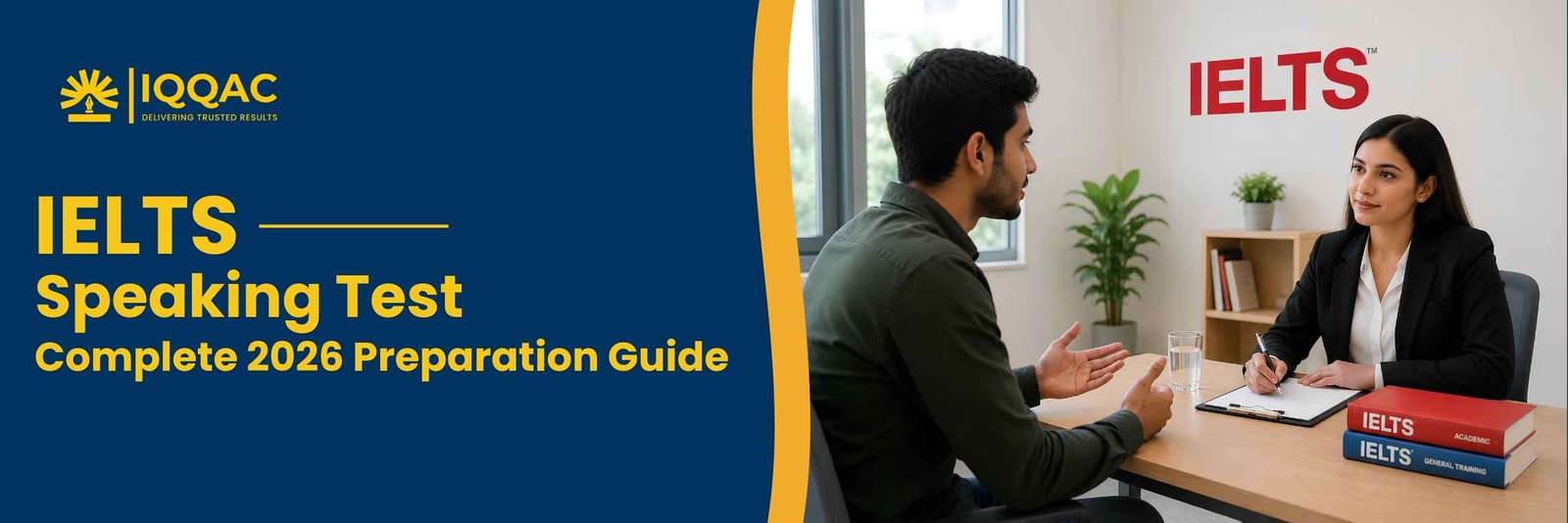
The IELTS speaking test consists of three parts and lasts 11-14 minutes. Face-to-face with an examiner.
Part 1 lasts 4-5 minutes. You reply to questions regarding your home, studies, work, family, pastimes, and everyday life. Do not give “one-word” answers, but rather give natural answers.
In Part 2, you’ll get a cue card. You have 1 minute to prepare and then up to 2 minutes to talk. Take rapid notes and then explain in a well-ordered way.
It takes 4-5 minutes to complete Part 3. The examiner prompts deeper questions that are related to Part 2. Express opinions, make comparisons, and discuss broader topics.
The Speaking and Listening papers are the same for Academic and General Training IELTS, but the Reading and Writing papers are not. Check the official IELTS speaking format before your test.
Know How Examiners Score You
The four skills of the IELTS speaking test are Fluency and Coherence, Lexical Resource, Grammatical Range and Accuracy, and Pronunciation.
Fluency is the ability to continue talking without pausing too long. Coherence is when your ideas are organised in a logical sequence. Vocabulary matters too. But you don’t need high-frequency words. Use words appropriately, based on their meaning.
The grammar corrects the control of a sentence. Use simple and longer sentences, but keep to accuracy. Pronunciation is the degree of understandability. An accent is not required to be copied.
With Band 6, aim for clear communication and minimal pauses. In Band 7, develop range, accuracy, and ideas. At the higher bands (Band 8 and above), aim for the following: flexible language, natural delivery. Compare your work with the official IELTS speaking criteria.
Follow an 8 Week Preparation Plan for the IELTS Speaking Test
Weeks 1 and 2
Know the structure and practice answering typical Part 1 questions. Pay attention to pausing, repeating words, and grammar errors.
Weeks 3 and 4
Build topic vocabulary. Select themes like Learning, technology, Health, Transport, Family, and Karachi. Memorize phrases, not entire answers.
Weeks 5 and 6
Practise cue cards every day. Allow 1 minute for preparation and 2 minutes for speaking. Practise Part 3 questions and articulate your opinion.
Weeks 7 and 8
Do timed practice tests. Write each test and self-grade. Identify areas of weakness and focus more effort on these.
If you have a very packed schedule, do 30 minutes a day. Divide into vocabulary, speaking, and review. Also practise your IELTS reading test to strengthen your overall preparation.
Improve Each Scoring Area for IELTS Speaking Test
Use timers and practice speaking fluently and continuously about one topic. Begin with the situation, include details, and end with your opinion. Use phrases to link ideas, including because of this, for example, and on the other hand.
Make small vocabulary lists by topic. Memorize phrases that you can use! For instance, learn “access to quality education” rather than rare words.
To practice grammar, use an error log. Record your recurring errors, fix them, and practice in sentences. To practice pronunciation, watch English videos and repeat after them. Reproduce rhythm and word stress. Shadowing can be used to become more fluent.
Use Part-by-Part Strategies for IELTS Speaking Test
Part 1
Answer directly, followed by one reason or example. When the examiner asks, “Do you like living in Karachi?” Don’t say only “Yes”. Explain why you like it and give a personal comment.
Part 2
Follow this outline: opening, details, personal example, and closing thought. When the card asks you, “What is something memorable?” answer it first. Then describe when, with whom, what, and why you remember this event.
Part 3
Provide an opinion, offer a reason, and include an example. Courteously discuss ideas and voice opinions. Sample answers are not models to be used as scripts. Substitute the information with your own life. This will make it easier for you to react to the questions the examiner asks naturally.
Avoid Common Speaking Mistakes
Several candidates provide brief answers due to fear of error. Instead, respond to the question and include a reason, detail, or example. Avoid memorised scripts. Examiners will be able to detect if there is a mismatch in your answer. Plan ideas and helpful phrases instead. Then eliminate filler words like “umm,” “you know,” and “like.” Acknowledge a need for time: “I need to take a pause” (or “That is an interesting question”).
An unexpected question may be thrown at you. Do not panic. State your opinion, why, and a brief example. It doesn’t require specialized knowledge. Always confirm the costs and dates as well as any fees, as they may change.
For Karachi candidates, check the IELTS test fee in Pakistan 2026 when planning your budget. Finally, keep your ID ready, arrive on time, follow staff instructions, and stay calm.
If you want another English test option, you can also check LanguageCert vouchers and compare them with your university or visa requirements.
Book your IELTS With IQQAC
IQQAC provides you with a safe and dependable space to take your English exam, and peace of mind from booking to test day. They can also provide you with preparation support to help you to be prepared and confident. Book an IELTS speaking test now to receive targeted feedback before your test.
Frequently Asked Questions
Q1: How long does the IELTS speaking test take?
This takes 11 to 14 minutes spread over three parts.
Q2: Can I use memorised answers in the IELTS speaking test?
Develop ideas but steer clear of scripts, as these may sound unnatural.
Q3: What should I do if I forget a word?
Repeat the meaning in another manner and continue speaking.
Q4: How can I practise for the IELTS speaking test at home?
Always write down answers with timing, check your work, and do it with a partner frequently.